
Livemuziek
Billy Cobham
A Surreal Experience
FLUOR, Amersfoort, NL, May 3rd, 2026
Text: Storm Bakker – Photos: Peter Lieberom
Billy Cobham is an artist who hardly needs an introduction. But out of respect and because we enjoy talking about him so much we will do it anyway. His story reads like a high speed rail line through jazz history. While the modern jazz drumming tradition was already rich and shaped by giants such as Elvin Jones and Tony Williams, something fundamentally shifted when Cobham emerged. Born in 1944 in Colón, Panama, and raised in New York, he absorbed a wide spectrum of influences early on. Inspired by masters like Art Blakey, Max Roach, and Roy Haynes, he developed a voice that was both deeply rooted and strikingly forward looking.

Horace and Miles
Through the disciplined, hard swinging grooves of Horace Silver’s ensembles, he became a driving force: no longer merely an accompanist, but a catalyst. His electrified, boundary breaking work with Miles Davis during the trumpeter’s electric period already revealed what was to come. Albums such as A Tribute to Jack Johnson and On the Corner feature an early version of Cobham’s approach: tight, aggressive, and already reaching beyond traditional timekeeping. He followed Williams and was himself succeeded by another drumming genius, Jack DeJohnette.
Mahavishnu
The real detonation occurred in 1971 alongside British visionary guitarist and composer John McLaughlin and his famous Mahavishnu Orchestra. A new musical universe took shape: fast, intricate, and spiritually charged. Here, jazz rock ceased to be a hybrid and became a fully realized, explosive language: a fusion of jazz, rock, blues, and Indian raga influences that left audiences in awe from the Fillmore East to the Montreux Jazz Festival.
Inspired by Mahavishnu, Cobham pushed boundaries through unconventional time signatures, extreme complexity, and rhythmic concepts infused with Indian and Balkan influences. In this period, his playing was nothing short of transformative. He became an architect of power, precision, and possibility: a living legend who elevated the drum kit into a leading voice within fusion and beyond. As one of the great innovators of the 1970s, Billy Cobham redefined the drum kit with a style that fused power and precision with a remarkable command of complex odd meters. His use of double bass drums, ambidexterity, and uncompromising energy became a blueprint for generations of jazz rock drummers.
Peak
After several years of worldwide touring that broke all rules and records, the original lineup came to an end. Cobham, who was replaced by Narada Michael Walden in subsequent Mahavishnu iterations, moved forward as a bandleader in his own right, performing his own powerful compositions. His groundbreaking solo debut, Spectrum (1973), featuring Czech keyboard virtuoso Jan Hammer (also ex Mahavishnu Orchestra), set a new benchmark for jazz fusion: more open, more powerful, and clearly bridging rock and funk.
Albums such as Crosswinds (1974) and Total Eclipse (1974) became essential listening, not just for drummers but for anyone serious about jazz rock. The albums Shabazz (1975, live), A Funky Thide of Sings (1975), and the enigmatic Inner Conflicts (1977) are highly regarded by a devoted circle of admirers. In those years, he collaborated with an extraordinary network of innovators: Jan Hammer, of course, but also the virtuosic Brecker Brothers, refined guitarists John Abercrombie and John Scofield, keyboardist George Duke, and bassist Stanley Clarke, to name a few.
Legacy
Cobham’s influence extends far beyond his own discography. He became a direct inspiration for generations of musicians across jazz, rock, and fusion: from the technically driven players of the 1980s to today’s genre fluid generation. Jazz rock and fusion may have had multiple origins, but in Billy Cobham, they found one of their most explosive engines. He did not just participate in the evolution of music: he accelerated it, shaped it, and left a legacy that continues to resonate.

Live at FLUOR Amersfoort, May 3
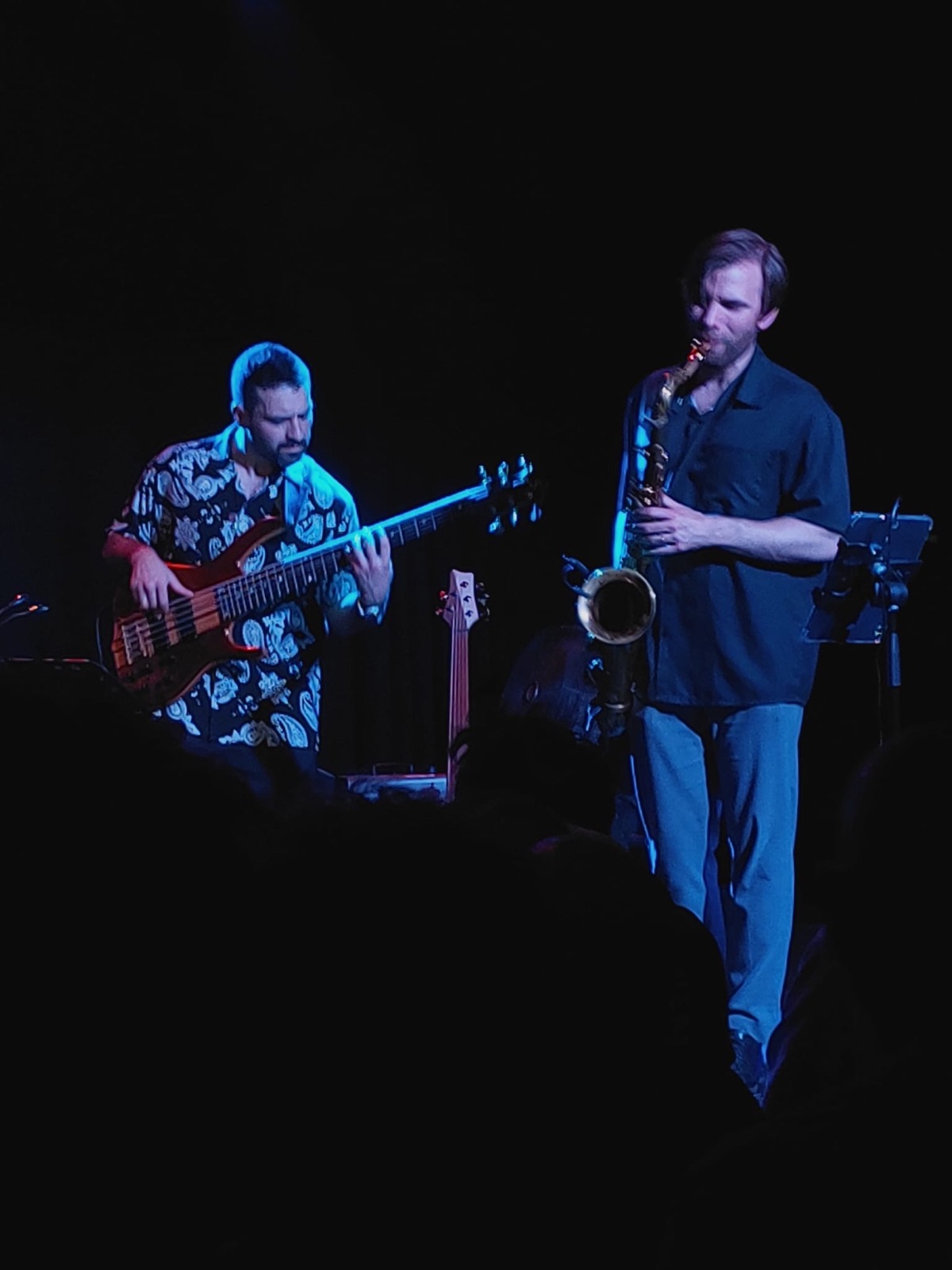
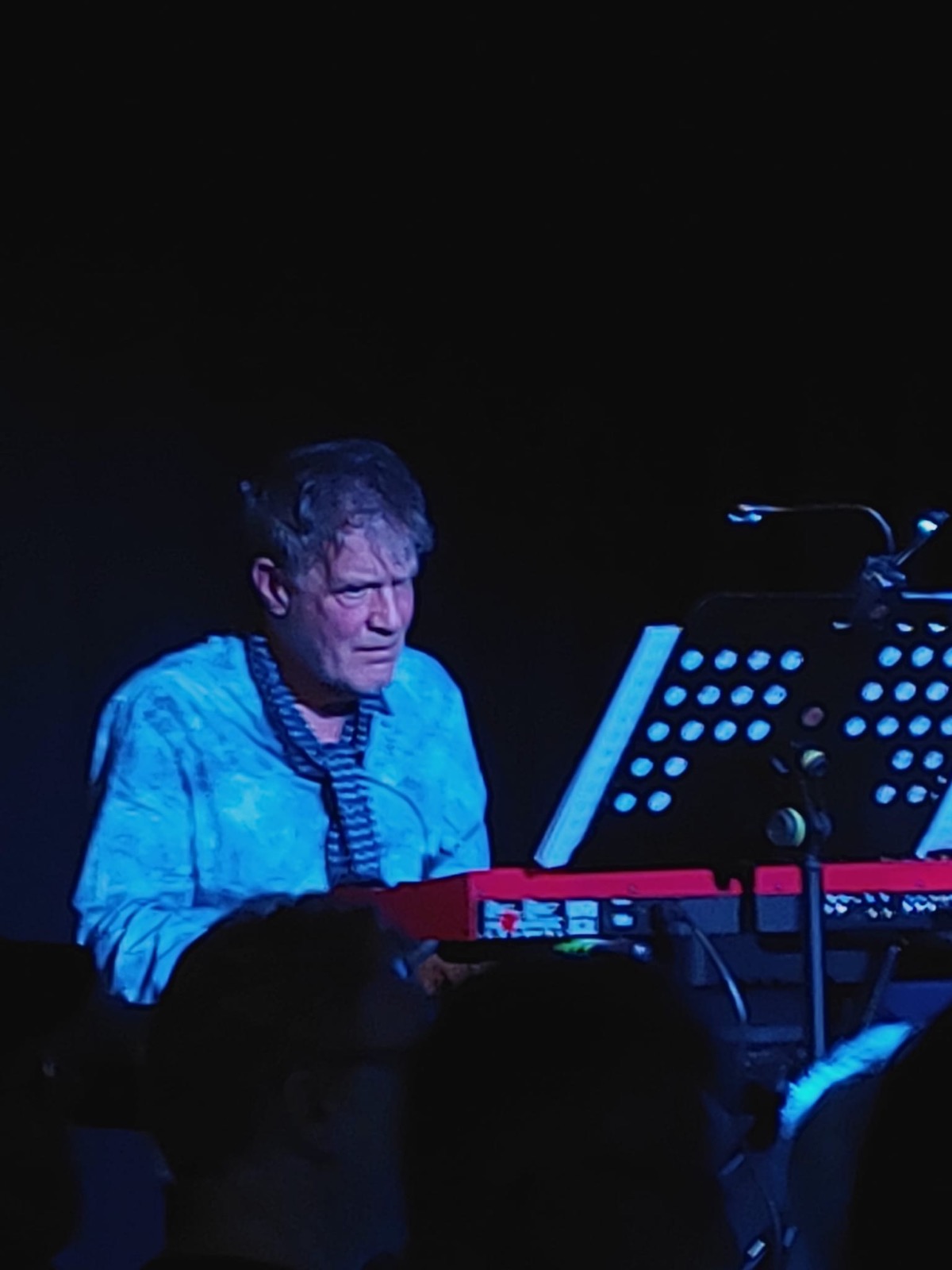
This legacy makes it all the more surreal to catch him not in a vast hall, but in a compact, sweat drenched club like FLUOR in Amersfoort during his European tour. A small room. No seats. Packed. It was hot enough to melt your drink before the first downbeat. Cobham, flanked by a razor sharp band called Time Machine, tore through works from his latest album, Times of My Life. The repertoire reflects decades of iconic music, including reworked versions of Stratus and Total Eclipse. These are not nostalgia pieces, but living, breathing organisms: stretched, twisted, and re energized. Keyboardist Gary Husband played with deep focus, almost disappearing into the music while uncovering unexpected textures and rhythmic detours. He attacks the keys like the drummer he is (having played with Allan Holdsworth and Level 42), often stepping outside the harmonic frame entirely. The Swedish saxophonist delivered a masterclass in invention: multiphonics, lightning fast runs, and electronic textures flirting with controlled chaos. The Italian guitarist was pure voltage, erupting from near silence into full shred mode in an instant with a rock attitude dialed to eleven. There were many hair raising moments. The bassist held it all together with taste and discipline: no excess, just a deep groove and total control. The sound of the band was full, rich, and transparent.
Face to Face
And Cobham? He joked between songs: “I should be in a home for the elderly. Unfortunately, that’s too expensive…” The man turns 82 in a few weeks, but he still hits like a freight train. While he is no longer as fluid or ultra virtuosic as in his earlier years, particularly regarding the double bass drum, he remains the force that once left arenas stunned into silence before they erupted in disbelief. He still has that sound. To witness this phenomenon, whose records have been spinning on our turntables for more than 40 years, face to face was nothing short of surreal. It is the kind of experience you do not expect in a venue like this, under these conditions: standing shoulder to shoulder, sweat dripping, and ears ringing. Credit where it is due: venues like FLUOR, Phil, and De Boerderij deserve serious respect for daring to program this kind of music. While many Dutch festivals have either disappeared or diluted themselves into safe, beige, “inclusive” lineups, it is these rooms that keep the real progressive fire alive.